Blog

  1. Inicio
  2. / Blog
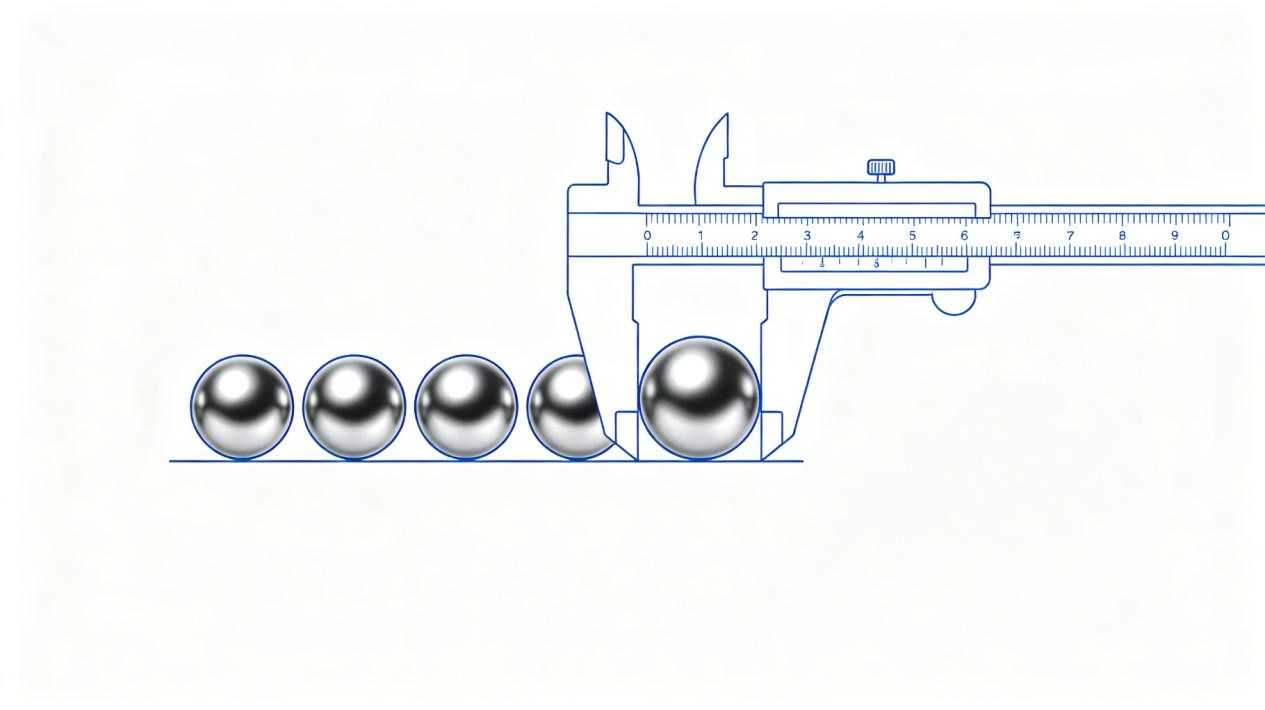
Caliper measuring precision balls for diameter tolerance inspection

Una guía sobre patrones de precisión esférica y métricas clave

Behind a single millimeter-sized ball lies an entire system of micron-level precision. Introduction In valve seals, VCM motors, precision bearings, and inspection fixtures, tiny precision balls — bearing steel balls, ceramic balls, cemented carbide (tungsten carbide) balls — are critical components that are easy to overlook. When selecting balls, engineers and buyers often get lost in grade designations such as G3, G5, and G10. If a drawing says “G5,” is that the same ball under the Chinese national standard, the U.S. ABMA, ISO, German DIN, and Japanese JIS? And what do all those symbols — Vdws, ΔSph, Vdwl — actually mean on the shop floor? This article skips the theory and answers three things: how the five major standards relate to each other, how to read the five core metrics, and where buyers most often go wrong. 01 Five major standards: one ball, five sets of rules Five precision systems are most commonly referenced in the industry: Standard Full name Where it is typically used GB/T 308.1 Chinese National Standard — rolling bearing balls General standard for bearing steel balls in China; cemented carbide balls refer to JB/T 9145 ABMA 10A American Bearing Manufacturers Association North American equipment, imported valves, foreign-invested projects ISO 3290 International Organization for Standardization The global baseline; most national standards are modeled on it DIN 5401 German Institute for Standardization (DIN) European precision equipment and German-made machinery JIS B 1501 Japanese Industrial Standard Japanese equipment, and spares for Japanese/Korean production lines Important note: identical grade designations do not mean unconditional interchangeability. Although G3/G5/G10 carry the same numbers across standards, the test criteria, measurement conditions, and sorting rules behind them differ in detail. For export projects, confirm the original standard your customer cites; for domestic substitution projects, select against GB/T 308 together with the actual operating conditions. Grade comparison: the smaller the number after “G”, the tighter the tolerance ISO 3290 is the international baseline, and China’s GB/T 308.1 is substantially equivalent to it. DIN 5401 aligns with the ISO grades, and the JIS B 1501 grade sequence is essentially the same. ABMA 10A was originally written in imperial units, which is why you often see an “A” suffix (G5A, G10A). In plain terms: the smaller the number after the “G”, the smaller the permitted error, and the better the ball’s roundness and dimensional consistency. GB/T 308.1 ISO 3290 DIN 5401 JIS B 1501 ABMA 10A G3 G3 G3 G3 G3 G5 G5 G5 G5 G5A G10 G10 G10 G10 G10A G16 G16 G16 G16 G16A G20 G20 G20 G20 G20A The grade sequences line up, but the actual tolerance limits are governed by the text of each individual standard. 02 Five core metrics: what each symbol actually means Five key metrics, one for each dimension of ball quality. Ball diameter variation (Vdws) — is the ball the same diameter in every direction? In plain terms: measure one ball’s diameter in different directions; Vdws is the difference between the largest and smallest reading. If this value runs high, the ball is effectively a flattened ellipsoid. At high speed that shows up as runout, vibration, and noise. In sealing applications, an ellipsoidal ball cannot form a complete circular sealing line against the seat, which leads directly to leakage. Deviation from spherical form (ΔSph) — how far from a perfect sphere? In plain terms: how far the ball’s outer surface deviates from a mathematically perfect sphere. In a perfect sphere, every point on the surface is the same distance from the center. The larger ΔSph is, the more likely the surface has local high or low spots. Under load, those spots concentrate stress and are prone to denting; at a sealing face, point contact causes seal failure. Where cemented carbide balls run against valve seats, ΔSph is the metric that matters most. Lot diameter variation (Vdwl) — how uniform is the batch? In plain terms: within one delivered lot, the size difference between the largest and the smallest ball. Perfect roundness on a single ball is not enough — every ball in the lot needs to be as close in size as possible. In multi-ball drives, caged bearings, counterweights, and multi-ball positioning, a lot with scattered sizes means uneven loading, jamming, and wobble. Many customers check only single-ball specifications and ignore lot consistency — and that is usually where assembly problems come from later. Surface roughness (Ra) — how smooth is the surface, microscopically? In plain terms: the degree of micro-level unevenness on the ball surface. The lower the Ra value, the smoother the surface. Under high-speed friction, rough surfaces generate heat and wear faster. In precision sealing, even a tiny high spot or scratch becomes a leak path for the medium. After fine grinding, cemented carbide balls can reach Ra 0.01 μm for demanding sealing applications. Nominal diameter deviation — how far from the drawing’s nominal size? In plain terms: how much the actual ball size is allowed to differ from the nominal dimension on the drawing. If the drawing calls for φ3 mm, how many microns plus or minus are permitted? Many engineers look only at the G5 grade and ignore the nominal diameter tolerance band. The grade is a baseline; a drawing can always tighten tolerances further. Two G5 orders can therefore carry quite different dimensional limits. 03 Selection pitfalls: three practical rules Don’t order by grade alone A purchasing specification should not say only “G5 cemented carbide balls”. Write down: the standard and its version (for example GB/T 308.1-2013), the nominal diameter, the limits for the five metrics above, and the surface quality requirement. The more complete the specification, the smaller the surprise on delivery. Replacing an imported part with a domestic ball? Verify the limits first If the original equipment drawing cites ABMA, check that the limits for deviation from spherical form, surface roughness, and lot diameter variation are consistent before you substitute a GB/T G5 ball. Confirm the metrics are equivalent first — otherwise you can end up with vibration or seal leakage after
Read More
cemented carbide balls tungsten steel banner

Todo lo que necesitas saber sobre las bolas de carburo cementado en un solo artículo

In the field of precision manufacturing, industry attention often focuses on large-scale equipment and complex structural components, making it all too easy to overlook small, basic components. Although cemented carbide balls (commonly known as tungsten steel balls) are unassuming miniature components, they directly determine the sealing precision, transmission stability, and overall service life of precision equipment, making them core industrial components essential for the long-term, stable operation of high-end machinery. At JNE New Material, we manufacture YG and YN series cemented carbide balls in diameters from 0.5 mm to 50 mm, with custom grades and sizes available on request. What Are Cemented Carbide Balls? Cemented carbide balls are high-precision spherical components manufactured using advanced powder metallurgy technology, with tungsten carbide as the hard matrix and cobalt or nickel as the binder phase. The industry primarily categorizes them into two main series: the YG series (tungsten-cobalt alloy) and the YN series (non-magnetic tungsten-nickel alloy). Compared to ordinary steel balls and bearing steel balls, the performance of both series of cemented carbide balls has been comprehensively upgraded. They address the pain points of traditional balls—such as susceptibility to wear, deformation, and corrosion, as well as poor precision—and can be specifically tailored to meet the precision manufacturing needs of different strengths, media, and operating conditions. They are currently the core foundational components in industrial precision manufacturing. Core Physical and Chemical Properties The outstanding adaptability of cemented carbide balls to various operating conditions stems from their stable and superior physical and chemical properties. At the same time, the YG and YN series exhibit significant differences in their properties due to variations in the binder phase material; this is the fundamental reason why these two product lines are suited for different operating conditions. Physical and Chemical Properties of Major Grades ① Physical Properties (by Grade): Property YG3X YG6 YG6X YG8 YG8N YG13 YN6 YN9 YN10 Test Condition Main Composition WC 97% Co 3% WC 94% Co 6% WC 94% Co 6% WC 92% Co 8% WC 91% Co 8% TaC 1% WC 87% Co 13% WC 94% Ni 6% WC 91% Ni 9% WC 90% Ni 10% Material specification Density (g/cm³) 15.0–15.3 14.7–15.0 14.7–15.0 14.5–14.9 14.8–14.9 14.0–14.4 14.5–14.9 14.2–14.6 14.0–14.4 Room temperature (23°C) Rockwell Hardness (HRA) 92–93.5 89.5–91 90–91.5 89–89.5 89.5–91.5 86–88 89–91 89–90 87–89 Room temperature (23°C) Flexural Strength (MPa) 1300–1800 1450–1600 1350–1700 1800–2300 1500–2000 2400–2800 1400–1800 1600–2000 1600–2200 Room temperature (23°C) Fracture Toughness (MPa·m1/2) 10–12 13–14 12–14 14–16 13–15 16–18 12–14 13–15 14–16 Room temperature (23°C) Temperature Resistance (°C) 400–500 400–500 400–500 400–500 400–500 400–500 400–500 400–500 400–500 23–1000°C Wear Resistance (Volumetric Wear Rate, mm³/(N·m)) ≤ 0.005 ≤ 0.008 ≤ 0.007 ≤ 0.01 ≤ 0.009 ≤ 0.02 ≤ 0.01 ≤ 0.015 ≤ 0.02 Dry sliding wear, room temperature Magnetic Properties Magnetic Magnetic Magnetic Magnetic Magnetic Magnetic Non-magnetic Non-magnetic Non-magnetic — ② Chemical Properties (by Grade): Property YG3X YG6 YG6X YG8 YG8N YG13 YN6 YN9 YN10 Test Condition Acid Resistance (Mass Loss Rate, %) < 0.1 < 0.1 < 0.1 < 0.1 < 0.1 < 0.1 < 0.1 < 0.1 < 0.1 Room temperature, 24 h, 10% hydrochloric acid Alkali Resistance (Mass Loss Rate, %) < 0.5 < 0.5 < 0.5 < 0.5 < 0.5 < 0.5 < 0.5 < 0.5 < 0.5 Room temperature, 24 h, 5% sodium hydroxide Resistance to Organic Solvents (Mass Loss Rate, %) < 0.05 < 0.05 < 0.05 < 0.05 < 0.05 < 0.05 < 0.05 < 0.05 < 0.05 72 h at room temperature, in ethanol/acetone High-Temp Oxidation Resistance (Mass Change Rate, %) < 0.2 < 0.2 < 0.2 < 0.2 < 0.2 < 0.2 < 0.2 < 0.2 < 0.2 1000°C, 100 h, in air High-Temp Acid & Alkali Corrosion Resistance (Mass Loss Rate, %) < 0.5 < 0.5 < 0.5 < 0.5 < 0.5 < 0.5 < 0.5 < 0.5 < 0.5 800°C/24 h, 20% sulfuric acid, 5% sodium hydroxide Thermal Shock Resistance (°C) 200–300 200–300 200–300 200–300 200–300 200–300 200–300 200–300 200–300 Rapid heating/cooling, no cracking Note: Data in this table is compiled from published material property tables of major cemented carbide grades and is provided for reference and comparison purposes. Exact values may vary by batch and manufacturing process — contact us for datasheets of specific grades. Full parameter table (including corrosion resistance, thermal conductivity, wear resistance and creep data for each grade): Precision Manufacturing Process The high precision and stability of cemented carbide balls rely not only on high-quality base materials but also on a standardized, meticulous powder metallurgy manufacturing process. Each step is subject to strict control to ensure consistent product quality. Precise Powder Blending: Formulations are tailored to each product series. The YG series uses a tungsten carbide + cobalt-based binder formulation, while the YN series employs a tungsten carbide + nickel-based binder formulation without added cobalt. For certain grades, trace amounts of TiN are added to refine grain size and enhance corrosion resistance. Thorough mixing via wet ball milling ensures uniform powder particle size and composition, establishing the performance differences between the two product lines at the source. Electronics and Digital Industry (YN Series): The YN series is non-magnetic, high-precision, and ultra-clean, free from magnetic interference. It is widely used in VCM (voice coil motors) and precision optical components, performing critical precision transmission functions such as lens autofocus and optical image stabilization. Precision Testing Instruments (YN Series): The YN series features stable material properties, is non-magnetic and corrosion-resistant, and exhibits minimal measurement error. It can be used as indenters for hardness testers, standard calibration spheres, and precision testing fixtures. General Industrial Applications (YG Series): The YG series offers excellent value for money and is wear-resistant and durable. It is widely used in precision bearings, pump seals, mechanical counterweights, sandblasting and grinding, and automated transmission equipment. Selection Guide: YG or YN? For general wear resistance, high-pressure sealing, mechanical counterweights, and general industrial applications, prioritize the YG series, which offers a balance of performance and cost-effectiveness. For non-magnetic environments, precision electronics, optical inspection, chemical corrosion, and high-cleanliness conditions, the YN series must be selected to avoid magnetic interference

Read More
products we offer

Productos que ofrecemos

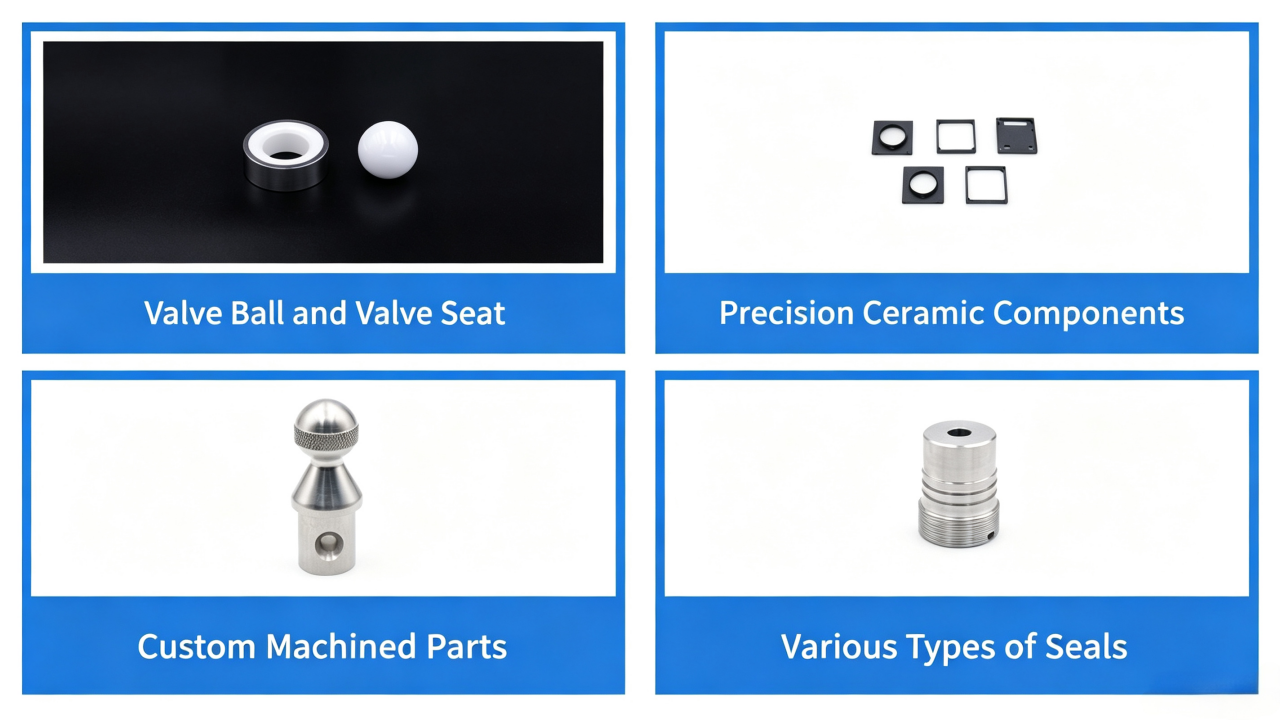
Principales categorías de productos Componentes esféricos de alta precisión, rodamientos y conjuntos de rodamientos, esferas y asientos de válvulas, piezas irregulares de precisión personalizadas Materiales mecanizables y aplicables Cerámicas (zirconia, alúmina, nitruro de silicio, carburo de silicio, etc.) Carburos cementados (YG3X, YG6, YG6X, YG8, YG8N, YG13, YN6, YN9, YN10, etc.) Aleaciones Monel (MONEL K400, MONEL K450, MONEL K500, etc.) Acero inoxidable (304, 316, 316L, 410, 420, 440C, etc.) Aleaciones Inconel (Inconel 600, Inconel 601, Inconel 625, Inconel 718, etc.) Aleaciones Stellite (Stellite 6B, Stellite 1, Stellite 4, STELLITE 8, STELLITE 12, STELLITE 20, etc.) Metales puros (aluminio, cobre, hierro, etc.) Otros metales (acero para rodamientos CGr15, aleación de titanio TC4, Hastelloy C276, etc.) Plásticos (POM, PP, PA, BB, PEEK, PTFE, etc.) Vidrio (vidrio óptico, etc.)

Read More
comparison of performance and applications of four major ceramic ball materials

Comparación del rendimiento y las aplicaciones de cuatro principales materiales para bolas cerámicas: bolas cerámicas de zirconia / alúmina / carburo de silicio / nitruro de silicio

Las esferas cerámicas se utilizan ampliamente en rodamientos de precisión, dispositivos médicos, aeroespacial, automotriz y equipos resistentes a la corrosión a altas temperaturas. Las esferas cerámicas fabricadas con diferentes materiales presentan diferencias significativas en propiedades fundamentales como dureza, densidad, resistencia a la temperatura y resistencia a la corrosión. A continuación se muestra una tabla comparativa de los parámetros de cuatro tipos principales de esferas cerámicas para facilitar la selección del producto. Parámetro Esferas cerámicas de zirconia Esferas cerámicas de alúmina Esferas cerámicas de carburo de silicio Esferas cerámicas de nitruro de silicio Imagen del producto Aspecto Blanco lechoso/beige Superficie fina y de alto brillo Acabado superficial extremadamente elevado Blanco puro Textura dura Aspecto limpio y uniforme Gris oscuro Acabado mate Textura densa y compacta Negro grisáceo Suave acabado mate Pulidas con precisión, sin rebabas Densidad (g/cm³) 6,05 3,9 3,2 3,25 Dureza Rockwell (HRA) 89-90 88-89 92-93 91-92 Resistencia a altas temperaturas (°C) 1000 °C 1200 °C 1600 °C 1300 °C Resistencia a la compresión (MPa) 2000 1800 2200 2100 Resistencia a la corrosión Resistente a ácidos y álcalis Resistente a la corrosión Excelente resistencia al envejecimiento Resistente a ácidos y álcalis débiles Usar con precaución en ambientes con ácidos y álcalis fuertes Resistencia excepcional a la corrosión Resistente a ácidos y álcalis fuertes Resistente a la erosión por disolventes Resistencia superior a la corrosión Adecuado para diversos entornos químicos agresivos Propiedades aislantes Alto grado de aislamiento No conductor Antiestático Aislamiento ultraalto Rendimiento eléctrico estable Semiaislante Conductividad eléctrica débil Alto grado de aislamiento Resistencia a altas temperaturas sin fugas eléctricas Características clave Excelente tenacidad Resistente a astillamientos y roturas Alto acabado superficial Resistente al desgaste y silenciosa Alta precisión Alta rentabilidad Suficiente dureza Buen aislamiento Resistencia a altas temperaturas y oxidación Textura uniforme Extremadamente versátil Ultra dura y ultra resistente al desgaste Resistencia a ultraltas temperaturas Resistencia superior a la corrosión Bajo coeficiente de fricción Resistente a altas temperaturas y presiones Vida útil extremadamente larga Alta tenacidad Resistencia a choques térmicos Resistencia a alternancias entre altas y bajas temperaturas Resistencia al desgaste y la fatiga Ligera Resistente a la acumulación de calor y daños durante operaciones a alta velocidad Principales industrias de aplicación Rodamientos de precisión Dispositivos médicos Maquinaria de procesamiento de alimentos Válvulas y núcleos de válvulas Equipos electrónicos Instrumentos de precisión Componentes de transmisión de alta velocidad Embalajes químicos Molienda y pulido Componentes de ferretería Sellos Rodamientos estándar Componentes de electrodomésticos Equipos de tratamiento de agua Equipos de alta temperatura Equipos resistentes a la corrosión química Aeroespacial Maquinaria metalúrgica Componentes resistentes a altas presiones y condiciones extremas Rodamientos de precisión de alta velocidad Equipos de energía eólica Componentes de precisión automotriz Aeroespacial Equipos de potencia para altas temperaturas Para más detalles sobre colores personalizados, por favor contacte con nuestro servicio de atención al cliente. Si necesita esferas cerámicas de precisión personalizadas, indíquenos las dimensiones específicas, tolerancias y condiciones de funcionamiento. Nuestro equipo técnico podrá desarrollar una solución a medida para usted. No dude en enviarnos sus planos y especificaciones para recibir un presupuesto gratuito.

Read More
about jne

Sobre JNE

Fundada en 2016 y con sede en Jiaxing, provincia de Zhejiang, JNE New Materials Co., Ltd. es una empresa nacional de alta tecnología especializada en I+D, fabricación inteligente e industrialización de nuevos materiales de alta gama. La compañía se centra en esferas de alta precisión, componentes de rodamientos de ultra precisión, asientos de válvulas de bola de alta precisión y diversos componentes de precisión personalizados de formas irregulares. Sus productos emplean una amplia variedad de materias primas de alta calidad, incluyendo zirconia, nitruro de silicio, carburo de silicio, alúmina, carburo cementado, aleaciones no magnéticas, aleaciones de alta densidad, acero inoxidable, zafiro, plástico y vidrio. La gama de productos abarca toda una serie de categorías, como cerámicas avanzadas, carburos cementados, aleaciones especiales, metales de precisión y plásticos. Con especificaciones completas y una precisión excepcional, nuestros productos cumplen con los exigentes estándares operativos requeridos por diversas aplicaciones de alta gama. En cuanto a la gestión, la empresa sigue un modelo operativo estandarizado, sistematizado y refinado, con una estructura organizativa interna clara y un sólido sistema de gestión. Ha obtenido las certificaciones ISO 9001:2015 para el Sistema de Gestión de la Calidad, ISO 14001:2015 para el Sistema de Gestión Ambiental y ISO 45001:2018 para el Sistema de Gestión de la Salud y Seguridad Ocupacional. Desde el punto de vista tecnológico, la empresa mantiene constantemente una estrategia de desarrollo impulsada por la innovación, otorgando gran importancia a la investigación y desarrollo de tecnologías clave propias y a la protección estratégica de la propiedad intelectual. Hasta la fecha, ha obtenido un total de 35 patentes propias, incluyendo 10 patentes de invención y 25 patentes de modelos de utilidad. Aprovechando su extensa cartera de tecnologías patentadas, la empresa ha establecido sólidas barreras tecnológicas fundamentales, impulsando continuamente la actualización de sus productos hacia mayores niveles de precisión, rendimiento y valor añadido, consolidando así de manera sostenida su posición líder en el sector. En términos de producción, la empresa opera una planta de fabricación moderna y de altos estándares, que ocupa más de 3.000 metros cuadrados. Equipada con salas limpias estandarizadas, avanzados equipos de procesamiento inteligentes y un completo conjunto de instrumentos de ensayo físico y químico de alta precisión, la instalación combina capacidades de producción masiva a gran escala con flexibles capacidades de I+D personalizada, garantizando una amplia capacidad productiva y entregas puntuales. Al mismo tiempo, la empresa ha establecido un sistema integral de servicios de extremo a extremo, ofreciendo a sus clientes servicios completos y atentos —incluyendo diseño de soluciones, desarrollo de prototipos, producción en serie, integración técnica y soporte postventa— para satisfacer de forma flexible las necesidades de personalización de cada cliente. En cuanto a los productos, la oferta de la empresa se utiliza ampliamente en numerosas industrias de alta tecnología y de vanguardia, incluyendo la aeroespacial, los instrumentos médicos de precisión de alta gama, los equipos de fluidos para semiconductores, los equipos de nueva energía, las comunicaciones 5G, la hidráulica y neumática de alta gama, los instrumentos y medidores de precisión, las válvulas industriales para fluidos y los equipos de automatización inteligente. Gracias a su excelente reputación, la empresa ha ganado la profunda confianza de numerosos clientes del sector. Su red de ventas cubre todo el país y sus productos se exportan tanto a mercados nacionales como internacionales. El equipo de JNE sigue firme en la defensa de los valores culturales fundamentales de la empresa: “Calidad sobresaliente, compromiso dedicado y excelencia excepcional”. Nos adherimos a nuestros principios fundacionales de artesanía, integridad y progreso pragmático, perfeccionando productos premium según estándares rigurosos y construyendo una base fiel de clientes mediante un servicio sincero. De cara al futuro, la empresa seguirá aumentando la inversión en investigación y desarrollo, enfocándose en la innovación tecnológica y la modernización industrial, y aspirará a convertirse en una marca nacional de primera clase en la fabricación inteligente de nuevos materiales de precisión de alta gama. Invitamos sinceramente a socios de todos los sectores a unir fuerzas, trabajar juntos y explorar conjuntamente nuevas oportunidades en la industria, mientras construimos un nuevo futuro de colaboración.

Read More