Blog

  1. Home
  2. / Blog
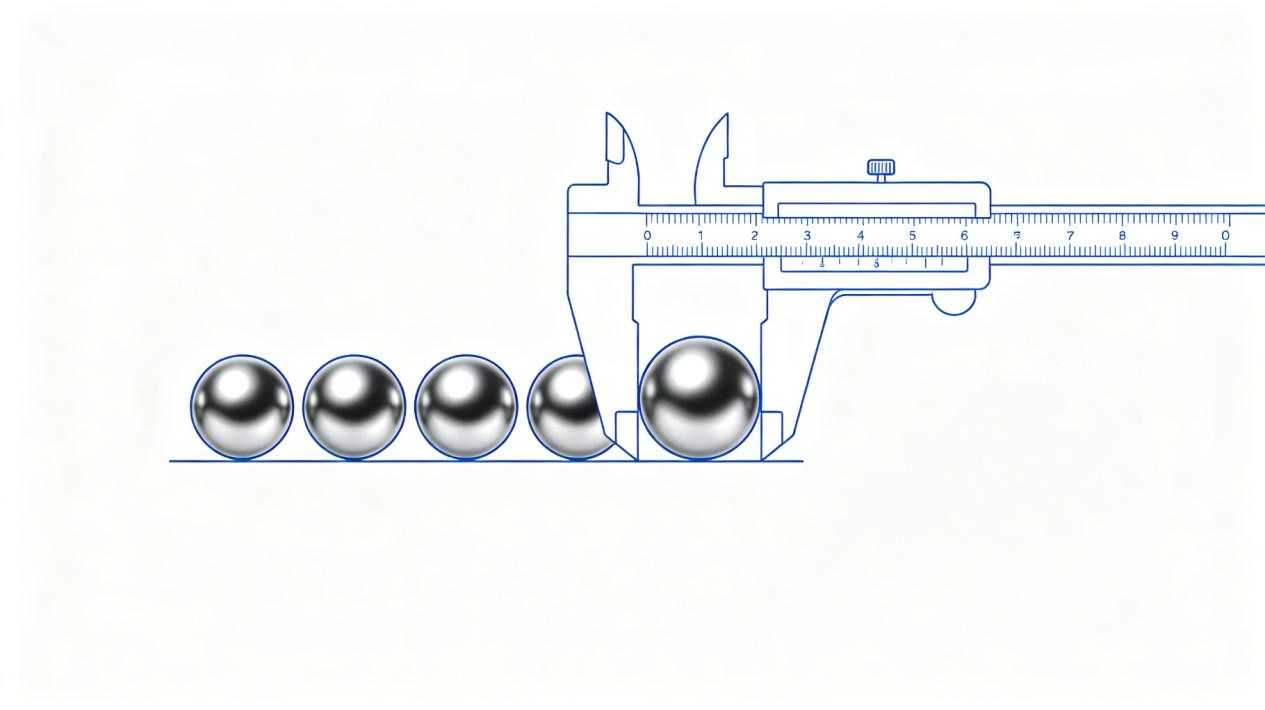
Caliper measuring precision balls for diameter tolerance inspection

A Guide to Spherical Precision Standards and Key Metrics

Behind a single millimeter-sized ball lies an entire system of micron-level precision. Introduction In valve seals, VCM motors, precision bearings, and inspection fixtures, tiny precision balls — bearing steel balls, ceramic balls, cemented carbide (tungsten carbide) balls — are critical components that are easy to overlook. When selecting balls, engineers and buyers often get lost in grade designations such as G3, G5, and G10. If a drawing says “G5,” is that the same ball under the Chinese national standard, the U.S. ABMA, ISO, German DIN, and Japanese JIS? And what do all those symbols — Vdws, ΔSph, Vdwl — actually mean on the shop floor? This article skips the theory and answers three things: how the five major standards relate to each other, how to read the five core metrics, and where buyers most often go wrong. 01 Five major standards: one ball, five sets of rules Five precision systems are most commonly referenced in the industry: Standard Full name Where it is typically used GB/T 308.1 Chinese National Standard — rolling bearing balls General standard for bearing steel balls in China; cemented carbide balls refer to JB/T 9145 ABMA 10A American Bearing Manufacturers Association North American equipment, imported valves, foreign-invested projects ISO 3290 International Organization for Standardization The global baseline; most national standards are modeled on it DIN 5401 German Institute for Standardization (DIN) European precision equipment and German-made machinery JIS B 1501 Japanese Industrial Standard Japanese equipment, and spares for Japanese/Korean production lines Important note: identical grade designations do not mean unconditional interchangeability. Although G3/G5/G10 carry the same numbers across standards, the test criteria, measurement conditions, and sorting rules behind them differ in detail. For export projects, confirm the original standard your customer cites; for domestic substitution projects, select against GB/T 308 together with the actual operating conditions. Grade comparison: the smaller the number after “G”, the tighter the tolerance ISO 3290 is the international baseline, and China’s GB/T 308.1 is substantially equivalent to it. DIN 5401 aligns with the ISO grades, and the JIS B 1501 grade sequence is essentially the same. ABMA 10A was originally written in imperial units, which is why you often see an “A” suffix (G5A, G10A). In plain terms: the smaller the number after the “G”, the smaller the permitted error, and the better the ball’s roundness and dimensional consistency. GB/T 308.1 ISO 3290 DIN 5401 JIS B 1501 ABMA 10A G3 G3 G3 G3 G3 G5 G5 G5 G5 G5A G10 G10 G10 G10 G10A G16 G16 G16 G16 G16A G20 G20 G20 G20 G20A The grade sequences line up, but the actual tolerance limits are governed by the text of each individual standard. 02 Five core metrics: what each symbol actually means Five key metrics, one for each dimension of ball quality. Ball diameter variation (Vdws) — is the ball the same diameter in every direction? In plain terms: measure one ball’s diameter in different directions; Vdws is the difference between the largest and smallest reading. If this value runs high, the ball is effectively a flattened ellipsoid. At high speed that shows up as runout, vibration, and noise. In sealing applications, an ellipsoidal ball cannot form a complete circular sealing line against the seat, which leads directly to leakage. Deviation from spherical form (ΔSph) — how far from a perfect sphere? In plain terms: how far the ball’s outer surface deviates from a mathematically perfect sphere. In a perfect sphere, every point on the surface is the same distance from the center. The larger ΔSph is, the more likely the surface has local high or low spots. Under load, those spots concentrate stress and are prone to denting; at a sealing face, point contact causes seal failure. Where cemented carbide balls run against valve seats, ΔSph is the metric that matters most. Lot diameter variation (Vdwl) — how uniform is the batch? In plain terms: within one delivered lot, the size difference between the largest and the smallest ball. Perfect roundness on a single ball is not enough — every ball in the lot needs to be as close in size as possible. In multi-ball drives, caged bearings, counterweights, and multi-ball positioning, a lot with scattered sizes means uneven loading, jamming, and wobble. Many customers check only single-ball specifications and ignore lot consistency — and that is usually where assembly problems come from later. Surface roughness (Ra) — how smooth is the surface, microscopically? In plain terms: the degree of micro-level unevenness on the ball surface. The lower the Ra value, the smoother the surface. Under high-speed friction, rough surfaces generate heat and wear faster. In precision sealing, even a tiny high spot or scratch becomes a leak path for the medium. After fine grinding, cemented carbide balls can reach Ra 0.01 μm for demanding sealing applications. Nominal diameter deviation — how far from the drawing’s nominal size? In plain terms: how much the actual ball size is allowed to differ from the nominal dimension on the drawing. If the drawing calls for φ3 mm, how many microns plus or minus are permitted? Many engineers look only at the G5 grade and ignore the nominal diameter tolerance band. The grade is a baseline; a drawing can always tighten tolerances further. Two G5 orders can therefore carry quite different dimensional limits. 03 Selection pitfalls: three practical rules Don’t order by grade alone A purchasing specification should not say only “G5 cemented carbide balls”. Write down: the standard and its version (for example GB/T 308.1-2013), the nominal diameter, the limits for the five metrics above, and the surface quality requirement. The more complete the specification, the smaller the surprise on delivery. Replacing an imported part with a domestic ball? Verify the limits first If the original equipment drawing cites ABMA, check that the limits for deviation from spherical form, surface roughness, and lot diameter variation are consistent before you substitute a GB/T G5 ball. Confirm the metrics are equivalent first — otherwise you can end up with vibration or seal leakage after
Read More
cemented carbide balls tungsten steel banner

Tutto ciò che devi sapere sulle sfere in carburo cementato in un unico articolo

In the field of precision manufacturing, industry attention often focuses on large-scale equipment and complex structural components, making it all too easy to overlook small, basic components. Although cemented carbide balls (commonly known as tungsten steel balls) are unassuming miniature components, they directly determine the sealing precision, transmission stability, and overall service life of precision equipment, making them core industrial components essential for the long-term, stable operation of high-end machinery. At JNE New Material, we manufacture YG and YN series cemented carbide balls in diameters from 0.5 mm to 50 mm, with custom grades and sizes available on request. What Are Cemented Carbide Balls? Cemented carbide balls are high-precision spherical components manufactured using advanced powder metallurgy technology, with tungsten carbide as the hard matrix and cobalt or nickel as the binder phase. The industry primarily categorizes them into two main series: the YG series (tungsten-cobalt alloy) and the YN series (non-magnetic tungsten-nickel alloy). Compared to ordinary steel balls and bearing steel balls, the performance of both series of cemented carbide balls has been comprehensively upgraded. They address the pain points of traditional balls—such as susceptibility to wear, deformation, and corrosion, as well as poor precision—and can be specifically tailored to meet the precision manufacturing needs of different strengths, media, and operating conditions. They are currently the core foundational components in industrial precision manufacturing. Core Physical and Chemical Properties The outstanding adaptability of cemented carbide balls to various operating conditions stems from their stable and superior physical and chemical properties. At the same time, the YG and YN series exhibit significant differences in their properties due to variations in the binder phase material; this is the fundamental reason why these two product lines are suited for different operating conditions. Physical and Chemical Properties of Major Grades ① Physical Properties (by Grade): Property YG3X YG6 YG6X YG8 YG8N YG13 YN6 YN9 YN10 Test Condition Main Composition WC 97% Co 3% WC 94% Co 6% WC 94% Co 6% WC 92% Co 8% WC 91% Co 8% TaC 1% WC 87% Co 13% WC 94% Ni 6% WC 91% Ni 9% WC 90% Ni 10% Material specification Density (g/cm³) 15.0–15.3 14.7–15.0 14.7–15.0 14.5–14.9 14.8–14.9 14.0–14.4 14.5–14.9 14.2–14.6 14.0–14.4 Room temperature (23°C) Rockwell Hardness (HRA) 92–93.5 89.5–91 90–91.5 89–89.5 89.5–91.5 86–88 89–91 89–90 87–89 Room temperature (23°C) Flexural Strength (MPa) 1300–1800 1450–1600 1350–1700 1800–2300 1500–2000 2400–2800 1400–1800 1600–2000 1600–2200 Room temperature (23°C) Fracture Toughness (MPa·m1/2) 10–12 13–14 12–14 14–16 13–15 16–18 12–14 13–15 14–16 Room temperature (23°C) Temperature Resistance (°C) 400–500 400–500 400–500 400–500 400–500 400–500 400–500 400–500 400–500 23–1000°C Wear Resistance (Volumetric Wear Rate, mm³/(N·m)) ≤ 0.005 ≤ 0.008 ≤ 0.007 ≤ 0.01 ≤ 0.009 ≤ 0.02 ≤ 0.01 ≤ 0.015 ≤ 0.02 Dry sliding wear, room temperature Magnetic Properties Magnetic Magnetic Magnetic Magnetic Magnetic Magnetic Non-magnetic Non-magnetic Non-magnetic — ② Chemical Properties (by Grade): Property YG3X YG6 YG6X YG8 YG8N YG13 YN6 YN9 YN10 Test Condition Acid Resistance (Mass Loss Rate, %) < 0.1 < 0.1 < 0.1 < 0.1 < 0.1 < 0.1 < 0.1 < 0.1 < 0.1 Room temperature, 24 h, 10% hydrochloric acid Alkali Resistance (Mass Loss Rate, %) < 0.5 < 0.5 < 0.5 < 0.5 < 0.5 < 0.5 < 0.5 < 0.5 < 0.5 Room temperature, 24 h, 5% sodium hydroxide Resistance to Organic Solvents (Mass Loss Rate, %) < 0.05 < 0.05 < 0.05 < 0.05 < 0.05 < 0.05 < 0.05 < 0.05 < 0.05 72 h at room temperature, in ethanol/acetone High-Temp Oxidation Resistance (Mass Change Rate, %) < 0.2 < 0.2 < 0.2 < 0.2 < 0.2 < 0.2 < 0.2 < 0.2 < 0.2 1000°C, 100 h, in air High-Temp Acid & Alkali Corrosion Resistance (Mass Loss Rate, %) < 0.5 < 0.5 < 0.5 < 0.5 < 0.5 < 0.5 < 0.5 < 0.5 < 0.5 800°C/24 h, 20% sulfuric acid, 5% sodium hydroxide Thermal Shock Resistance (°C) 200–300 200–300 200–300 200–300 200–300 200–300 200–300 200–300 200–300 Rapid heating/cooling, no cracking Note: Data in this table is compiled from published material property tables of major cemented carbide grades and is provided for reference and comparison purposes. Exact values may vary by batch and manufacturing process — contact us for datasheets of specific grades. Full parameter table (including corrosion resistance, thermal conductivity, wear resistance and creep data for each grade): Precision Manufacturing Process The high precision and stability of cemented carbide balls rely not only on high-quality base materials but also on a standardized, meticulous powder metallurgy manufacturing process. Each step is subject to strict control to ensure consistent product quality. Precise Powder Blending: Formulations are tailored to each product series. The YG series uses a tungsten carbide + cobalt-based binder formulation, while the YN series employs a tungsten carbide + nickel-based binder formulation without added cobalt. For certain grades, trace amounts of TiN are added to refine grain size and enhance corrosion resistance. Thorough mixing via wet ball milling ensures uniform powder particle size and composition, establishing the performance differences between the two product lines at the source. Electronics and Digital Industry (YN Series): The YN series is non-magnetic, high-precision, and ultra-clean, free from magnetic interference. It is widely used in VCM (voice coil motors) and precision optical components, performing critical precision transmission functions such as lens autofocus and optical image stabilization. Precision Testing Instruments (YN Series): The YN series features stable material properties, is non-magnetic and corrosion-resistant, and exhibits minimal measurement error. It can be used as indenters for hardness testers, standard calibration spheres, and precision testing fixtures. General Industrial Applications (YG Series): The YG series offers excellent value for money and is wear-resistant and durable. It is widely used in precision bearings, pump seals, mechanical counterweights, sandblasting and grinding, and automated transmission equipment. Selection Guide: YG or YN? For general wear resistance, high-pressure sealing, mechanical counterweights, and general industrial applications, prioritize the YG series, which offers a balance of performance and cost-effectiveness. For non-magnetic environments, precision electronics, optical inspection, chemical corrosion, and high-cleanliness conditions, the YN series must be selected to avoid magnetic interference

Read More
products we offer

Prodotti che offriamo

Principali categorie di prodotti Componenti sferici ad alta precisione, cuscinetti e gruppi cuscinetto, sfere e sedi valvolari, particolari di precisione su misura di forma irregolare Materiali lavorabili e applicabili Ceramiche (zirconia, allumina, nitruro di silicio, carburo di silicio, ecc.) Carburi cementati (YG3X, YG6, YG6X, YG8, YG8N, YG13, YN6, YN9, YN10, ecc.) Leghe Monel (MONEL K400, MONEL K450, MONEL K500, ecc.) Acciaio inossidabile (304, 316, 316L, 410, 420, 440C, ecc.) Leghe Inconel (Inconel 600, Inconel 601, Inconel 625, Inconel 718, ecc.) Leghe Stellite (Stellite 6B, Stellite 1, Stellite 4, STELLITE 8, STELLITE 12, STELLITE 20, ecc.) Metalli puri (alluminio, rame, ferro, ecc.) Altri metalli (acciaio per cuscinetti CGr15, lega di titanio TC4, Hastelloy C276, ecc.) Materie plastiche (POM, PP, PA, BB, PEEK, PTFE, ecc.) Vetro (vetro ottico, ecc.)

Read More
comparison of performance and applications of four major ceramic ball materials

Confronto tra prestazioni e applicazioni di quattro principali tipologie di sfere ceramiche: sfere in zirconia / allumina / carburo di silicio / nitruro di silicio

Le sfere ceramiche sono ampiamente utilizzate nei cuscinetti di precisione, nei dispositivi medici, nell’aerospazio, nell’industria automobilistica e nelle attrezzature resistenti alla corrosione ad alte temperature. Le sfere ceramiche realizzate con materiali diversi presentano differenze significative nelle proprietà fondamentali, quali durezza, densità, resistenza alle temperature e resistenza alla corrosione. Di seguito è riportata una tabella comparativa dei parametri relativi a quattro tipologie principali di sfere ceramiche, utile per la selezione del prodotto.   Parametro Sfere ceramiche in zirconia Sfere ceramiche in allumina Sfere ceramiche in carburo di silicio Sfere ceramiche in nitruro di silicio Immagine del prodotto Aspetto Bianco latte/beige Superficie lucida e finissima Finitura superficiale estremamente elevata Bianco puro   Texture dura   Aspetto ordinato e uniforme Grigio nerastro   Finitura opaca   Texture densa e compatta Nero-grigiastro Liscia   finitura opaca   Lucidata con precisione, priva di bave   Densità(g/cm³) 6,05 3,9 3,2 3,25 Durezza Rockwell(HRA) 89-90 88-89 92-93 91-92 Resistenza alle alte temperature(°C) 1000°C 1200°C 1600°C 1300°C Resistenza alla compressione(MPa) 2000 1800 2200 2100 Resistenza alla corrosione Resistente ad acidi e alcali Corrosione-resistente   Eccellente resistenza all’invecchiamento Resistente ad acidi e alcali deboli   Usare con cautela in ambienti fortemente acidi e alcalini Estremamente resistente alla corrosione   Resistente ad acidi e alcali forti   Resistente all’erosione da solventi Superiore resistenza alla corrosione   Adatto a vari ambienti chimici aggressivi   Proprietà isolanti Elevata isolazione   Non conduttivo   Antistatico Isolazione ultra-elevata   Prestazioni elettriche stabili Semiconduttivo   Debole conducibilità elettrica Elevata isolazione   Resistenza alle alte temperature senza dispersione elettrica   Caratteristiche principali Eccellente tenacità   Resistente a scheggiature e rotture   Alta finitura superficiale   Resistente all’usura e silenziosa   alta precisione Ottimo rapporto costo‑efficacia   sufficiente durezza   buona isolazione   resistenza alle alte temperature e all’ossidazione   texture uniforme   estremamente versatile Ultra‑duro e ultra‑resistente all’usura   ultra‑alta resistenza alle temperature   superiore resistenza alla corrosione   basso coefficiente di attrito   resistente ad alte temperature e pressioni   durata di servizio estremamente lunga Alta tenacità   resistenza agli shock termici   resistenza a temperature alternate alte e basse   resistenza all’usura e alla fatica   leggero   resistente all’accumulo di calore e ai danni durante il funzionamento ad alta velocità Principali settori di applicazione Cuscinetti di precisione   Dispositivi medici   Macchinari per la lavorazione alimentare   Valvole e nuclei valvolari   Apparecchiature elettroniche   Strumenti di precisione   Componenti per trasmissioni ad alta velocità Imballaggio chimico   Lavorazione e lucidatura   Componenti hardware   Guarnizioni   Cuscinetti standard   Componenti per elettrodomestici   Attrezzature per il trattamento delle acque Attrezzature ad alte temperature   Attrezzature resistenti alla corrosione chimica   Aerospazio   Macchinari metallurgici   Componenti resistenti all’usura ad alta pressione   Componenti per condizioni operative estreme Cuscinetti di precisione ad alta velocità   Attrezzature per l’energia eolica   Componenti di precisione per l’automotive   Aerospazio   Attrezzature per l’energia ad alte temperature   Per ulteriori dettagli sui colori personalizzati, si prega di contattare il servizio clienti.   Se avete bisogno di sfere ceramiche di precisione su misura, fornite le dimensioni specificate, le tolleranze e le condizioni operative. Il nostro team tecnico sarà in grado di sviluppare una soluzione su misura per voi. Non esitate a inviarci i vostri disegni e le specifiche per ricevere un preventivo gratuito.

Read More
about jne

Informazioni su JNE

Fondata nel 2016 e con sede a Jiaxing, nella provincia dello Zhejiang, la JNE New Materials Co., Ltd. è un’impresa ad alta tecnologia di livello nazionale, specializzata nella ricerca e sviluppo, nella produzione intelligente e nell’industrializzazione di nuovi materiali di fascia alta. L’azienda si distingue per la produzione di sfere ad altissima precisione, componenti per cuscinetti di ultra‑precisione, sedi di valvole a sfera di elevata precisione e vari componenti di precisione su misura di forme irregolari. I suoi prodotti impiegano una vasta gamma di materie prime di alta qualità, tra cui zirconia, nitruro di silicio, carburo di silicio, allumina, carburo cementato, leghe non magnetiche, leghe ad alta densità, acciaio inossidabile, zaffiro, plastica e vetro. La gamma dei prodotti copre l’intera serie di categorie, incluse ceramiche avanzate, carburi cementati, leghe speciali, metalli di precisione e plastiche. Con specifiche complete e una precisione eccezionale, i nostri prodotti soddisfano i rigorosi standard operativi richiesti da numerose applicazioni di alto livello. Sul piano gestionale, l’azienda adotta un modello operativo standardizzato, sistematizzato e raffinato, caratterizzato da una chiara struttura organizzativa interna e da un solido sistema di management. Ha ottenuto le certificazioni ISO 9001:2015 per il Sistema di Gestione della Qualità, ISO 14001:2015 per il Sistema di Gestione Ambientale e ISO 45001:2018 per il Sistema di Gestione della Salute e Sicurezza sul Lavoro. Dal punto di vista tecnologico, l’azienda segue costantemente una strategia di sviluppo guidata dall’innovazione, attribuendo grande importanza alla ricerca e allo sviluppo di tecnologie core proprietarie e alla protezione strategica della proprietà intellettuale. Ad oggi, ha ottenuto complessivamente 35 brevetti proprietari, tra cui 10 brevetti d’invenzione e 25 brevetti per modelli di utilità. Sfruttando il suo ampio portafoglio di tecnologie brevettate, l’azienda ha creato solide barriere tecnologiche fondamentali, promuovendo continuamente l’aggiornamento dei prodotti verso una precisione sempre più elevata, prestazioni superiori e maggior valore aggiunto, consolidando così stabilmente la propria posizione di leadership nel settore. Sul fronte produttivo, l’azienda dispone di uno stabilimento moderno e di alto standard, esteso su oltre 3.000 metri quadrati. Dotato di camere bianche standardizzate, avanzate attrezzature di lavorazione intelligenti e di un’intera serie di strumenti di prova fisici e chimici ad alta precisione, lo stabilimento combina capacità di produzione di massa su larga scala con flessibili capacità di ricerca e sviluppo personalizzate, garantendo ampia capacità produttiva e consegne puntuali. Al contempo, l’azienda ha istituito un sistema di servizi integrati, end-to-end, offrendo ai clienti assistenza completa e attenta — inclusi progettazione di soluzioni, sviluppo di prototipi, produzione di massa, integrazione tecnica e supporto post‑vendita — per rispondere con flessibilità alle esigenze di personalizzazione di ciascun cliente. Per quanto riguarda i prodotti, l’offerta dell’azienda è ampiamente impiegata in numerosi settori ad alta tecnologia e all’avanguardia, tra cui l’aerospazio, gli strumenti medici di precisione di fascia alta, le apparecchiature per fluidi nel settore dei semiconduttori, le attrezzature per le nuove energie, le comunicazioni 5G, l’idraulica e la pneumatica di alta gamma, gli strumenti e i misuratori di precisione, le valvole industriali per fluidi e le apparecchiature di automazione intelligente. Grazie alla sua eccellente reputazione, l’azienda ha conquistato la profonda fiducia di numerosi clienti del settore. La rete di vendita copre l’intero territorio nazionale e i prodotti vengono esportati sia sul mercato interno che su quello internazionale. Le persone di JNE rimangono saldamente impegnate a difendere i valori culturali fondamentali dell’azienda: “Qualità eccellente, impegno dedicato ed eccellenza straordinaria”. Ci atteniamo ai principi fondanti di artigianalità, integrità e progresso pragmatico, perfezionando prodotti di prim’ordine secondo standard rigorosi e costruendo una base di clienti fedeli attraverso un servizio sincero. Guardando al futuro, l’azienda continuerà ad aumentare gli investimenti in ricerca e sviluppo, concentrandosi sull’innovazione tecnologica e sull’aggiornamento industriale, impegnandosi a costruire un marchio nazionale di primo livello per la produzione intelligente di nuovi materiali di precisione di alta gamma. Invitiamo sinceramente partner di tutti i settori a unire le forze, collaborare e esplorare insieme nuove opportunità nel settore, creando un nuovo futuro di cooperazione.

Read More